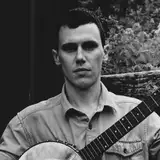
Black walnut neck and tuners, bridge +tailpiece. Poplar hoop. Deer bone nut and fifth string pip. Brass screws. Copper wire.
The head is Jamaican goat skin from Jeff Menzies (https://jeffreymenzies.com/)
Sold to a gentleman out in Arizona.
2018-04-05 00:40:57 +0000 UTC
View Post
In an earlier video I mentioned that I possessed this evidently rare recording of William 'Banjo Bill' Cornett playing and singing two versions of the Knott County, Kentucky banjo blues song "Morphine." The two versions I clipped together in here appear to be from the same tapes used for the album "Lost Recordings of Banjo Bill Cornett" (Field Recorders' Collective 2005)--however, they were myster...
2018-04-03 15:04:33 +0000 UTC
View Post
Here are a few images I've gathered that are unusual in the sense that they portray banjo players "in the field" rather than a typical studio setting. Check out that wild neck profile on the banjo pictured above ^ for starters!

United States Army camp, 1861-65, unknown location.
 2018-04-03 12:01:00 +0000 UTC
View Post
2018-04-03 12:01:00 +0000 UTC
View Post
https://www.patreon.com/cliftonhicks
https://www.cliftonhicks.bandcamp.com
Here's the new banjo I have been building for someone who's actually an old friend of mine. The instrument is almost complete and ready to ship out, but I am stil...
2018-04-02 20:10:27 +0000 UTC
View Post
(relative tuning: gDGBD)
Here's a close-up of Clif's left hand playing through the first and second parts of "White House Blues" (aka If I Lose Let Me Lose, All You Fascists, Railroad Bill, Washington Blues etc.) George R. Gibson, banjo player, balladeer, author and historian from Knott County, Kentucky showed me how to play the tune something like this years ago. (To slow down or speed th...
2018-03-31 21:43:32 +0000 UTC
View Post
(relative tuning: gDGBD) Here's a close-up of Clif's right hand playing through the first and second parts of "White House Blues" (aka If I Lose Let Me Lose, All You Fascists, Railroad Bill, Washington Blues etc.) George R. Gibson, banjo player, balladeer, author and historian from Knott County, Kentucky showed me how to play the tune something like this years ago. (To slow down or spe...
2018-03-31 21:40:59 +0000 UTC
View Post
https://kentuckyexplorer.com/nonmembers/01-02033.html
(The following is the conclusion to "The Banjo in Appalachia" by George R. Gibson and published in 2000 by Kentucky Explorer Magazine.)
The Banjo In Appalachia
(Conclusion)
...
2018-03-30 12:00:01 +0000 UTC
View Post
A while ago I performed this piece for you; today let's take a closer look at the basic techniques which make up the song. Look out in the near future for some close up shots of the right and left hand work.
https://www.patreon.com/cliftonhicks
2018-03-29 22:30:37 +0000 UTC
View Post
John sent us some fascinating info and a question about "Boil Them Cabbage Down." Also, is Clifton Hicks related to Stanley Hicks, Dee Hicks or any of the noted Appalachian Hicks families?
And check out the NEW BANJO! I'm making this for a friend and it is sort of a surprise. Black walnut neck and tuners, poplar pot, deer bone nut.
2018-03-29 02:41:28 +0000 UTC
View Post
In banjo researcher George R. Gibson's 2002 article 'Gourd Banjos: from Africa to the Appalachians' note the following citation:
'Banjo playing in Tidewater Virginia is described in the Journal and Letters of Philip Vickers Fithian. Fithian was a tutor at Nomini Hall, owned by Robert Carter. The Carter family was one of the most prominent in Virginia. Carter employed, in addition to Fithian, bot...
2018-03-25 17:27:53 +0000 UTC
View Post
Most of us know that the American five-string banjo traces it's history to a family of west African musical instruments that were introduced to North America via the Atlantic slave trade.
Blacks, whites, natives and people of mixed race worked, lived and began forming families together along the southern frontier of colonial America beginning in the mid-1600s. Historical evidence of black Americ...
2018-03-24 21:50:53 +0000 UTC
View Post
'From at least as early as the late 18th century, then, African American banjo players could be found in Appalachia. This fact is not surprising, since one would expect that they could be found wherever African Americans could be found. Many whites migrating into Appalachia from the east would have brought enslaved African Americans with them, some of whom would play the banjo. To illustrate this ...
2018-03-24 19:22:00 +0000 UTC
View Post
Following is an outline of essential reading for those seriously interested in the general history of the banjo.
"It is difficult to find much personal information in written history about the classes that played the banjo: slaves, freed slaves, indentured servants, wage earners, backwoodsmen; all people of limited means. One quickly realizes that history, for the most part, was not writte...
2018-03-22 22:27:24 +0000 UTC
View Post
"Lee and Opal Sexton are subsistence farmers living at the head of a hollow, at the end of Dead End Road in Linefork, Kentucky. Opal carefully preserves all that their garden produces. Lee, a retired coal miner and legendary banjo player, continues to perform at square dances and teach his distinctive style of playing to a new generation. They hail from a vanishing traditional culture. Lee is a vi...
2018-03-21 18:10:07 +0000 UTC
View Post
The last time I showed yall this black walnut banjo neck I've been working on it was basically a rough block of wood with the beginning of a tenon and the neck outline traced on one side.
My method of carving these necks down involves making a series of cuts with backsaw or electric jigsaw, then clamping the work piece and chiseling off the small "dominoes" that were left over from the repetitiv...
2018-03-21 16:55:02 +0000 UTC
View Post
(Banjo is tuned 1.5 steps below fDGCD)
Before moving on to the next song I need to wrap up this series on Cumberland Gap with a brief discussion on my technical approach to the song. In this segment I'll focus mainly on the left hand chording, pulls and hammers that really make this an outstanding version of the classic song.
According to Bascam Lamar Lunsford, "Cumberland Gap" is a...
2018-03-21 10:00:01 +0000 UTC
View Post
"On today’s show I speak with Clifton Hicks, a great young banjo player originally from Florida and Georgia who now resides in Boone, NC. I’ve known and known about Clif for a while now, ever since he sent in his home recordings to Down Home Radio. I was blown away by his singing and playing and was very ha...
2018-03-20 12:01:00 +0000 UTC
View Post
In this segment I'll play a version of Pretty Polly inspired by the recent tablature posted by Justin over in the Community section at https://patreon.com/cliftonhicks and Louie asks whether trying to learn 2, 3 or more songs at a time is worthwhile.
http...
2018-03-19 11:01:00 +0000 UTC
View Post
"My research of banjo history in Knott County, Kentucky, and the surrounding area is on-going. Listed below are a few notes regarding African American musicians in east Kentucky. " - George R. Gibson
Old-Time Kentucky Fiddle Tunes by Jeff Todd Titon, published in 2001 by the University Press of Kentucky. This book contains information about Manon Campbell, a Letcher County fiddler:<...
2018-03-19 07:01:58 +0000 UTC
View Post
Here's a somewhat slowed-down and close-up shot of the little interlude I sometimes play up the neck in between the standard A and B parts of Cumberland Gap.
Most of the better traditional banjo players used a similar instrumental break to add variety to this otherwise common tune. Mine is fairly simple--there are many other ways to do this and I encourage you to seek out older recordings when c...
2018-03-18 13:00:01 +0000 UTC
View Post
"If the banjo was commonly known over a large area by 1750, as I assume, then it must have been introduced two or more generations prior to 1750. It is likely, therefore, that the amalgamation of music from Africa and Europe, and the adoption of the banjo by whites, began during the early colonial era, from 1620 to about 1670 when the distinction between indentured servants and slaves was no...
2018-03-18 12:00:01 +0000 UTC
View Post
(Banjo tuned to e♭CFB♭C -- relative fDGCD)
Here's the left hand work for Cumberland Gap. I picked up this way of playing the song from listening to recordings of Morgan and Lee Sexton of Kentucky.
(All close-ups filmed by Robyn M. Latham)
https://www.patreon.com/cliftonhicks
2018-03-17 16:03:22 +0000 UTC
View Post
In 2010 George Gibson and I sat with New York musician, teacher, organizer etc. Eli Smith for a pair of interviews.
------------------------------------------------------------------------------------
On today’s show I speak with Eastern Kentucky banjo player George Gibson. I was lucky enough to catch up with George when we were both participating in 2018-03-17 13:00:01 +0000 UTC
View Post
(The following is an interesting piece of personal correspondence from master banjo player and historian George R. Gibson.)
Gibson's latest research into the evolution of American banjo culture is soon to be published in the forthcoming edited volume: Banjo Roots and Branches (University of Illinois Press:
2018-03-17 00:56:11 +0000 UTC
View Post
(Banjo tuned to e♭CFB♭C -- relative fDGCD)
A while back I posted a performance of this song, here is the right hand close-up. I figured out this way of picking the tune from listening to recordings of Kentucky banjo players Lee Sexton and Morgan Sexton.
I tend to play these close-ups at about 3/4 speed; if you want to watch it slower (or faster) click the little watch cog symbol ...
2018-03-17 00:05:19 +0000 UTC
View Post
gDGBD, relative (tuned down to F)
"White House Blues/All You Fascists/Railroad Bill" (originally recorded by Charlie Poole in 1926). While, my version may sound similar to Poole's at first glance (we are both finger picking) I actually learned to play this tune and it's cousin "Lonesome Road Blues/Going Down This Road Feeling Bad" from George Gibson of Knott County, KY circa 1999-2000. I was pre...
2018-03-16 12:01:00 +0000 UTC
View Post
Before we can dive into any of the more advanced techniques that involve noting the banjo above the fifth fret, it's necessary to understand a little bit of the geometry involved in the layout of the frets, strings and bridge.
https://www.patreon.com/cliftonhicks
2018-03-15 12:00:00 +0000 UTC
View Post
Daniel has a fascinating question about singing in foreign accents and Adam needs a word of advice on transitioning from tablature to learning by ear.
https://www.patreon.com/cliftonhicks
https://cliftonhicks.bandcamp.com/
2018-03-14 12:00:01 +0000 UTC
View Post
Will wants to know more about the friction tuners on his 'new' antique banjo: can/should he upgrade? And Ryan is having one Hell of a time shopping for a left-handed antique banjo.
https://www.patreon.com/cliftonhicks
https://cliftonhicks.bandc...
2018-03-13 16:22:21 +0000 UTC
View Post
(Dan Torigoe is a dude from Japan who spends most of his time studying traditional American folk music and travelling around, mostly the southeast, recording it. Check out Dolceola Recordings https://www.facebook.com/dolceola.recordings/ to see more of his work.)
Jack learned to play music from his uncle ...
2018-03-13 09:10:29 +0000 UTC
View Post