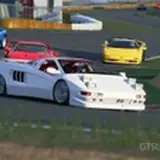
It is a text about the car who shared some thing and story in common with Porshe 959. It was not a winner, but set some great results, left it's sign in world autosport history and not less unique.
~~~ two in game shots. all cars featured for AC by us ~~~


The idea of creating a mid-engined rally car based on the Lada Samara was born in the first half of the 80s. The ultimate goal is the participation of the car in the rally championship in the Group B category.
magazine "Behind the wheel" 04.1985 - translated to english
“... In 1983, the Autosport Federation of USSR decided to hold a separate USSR rally championship on cars prepared under group B regulations in class 9 (up to 2000 cm3). "
LADA Samara Rally was created in the Bureau of Forced Tests of UGK VAZ on the basis of VAZ-2108. Fundamental changes: the central location of the power unit (the engine is located behind the seats), the layout is classic (rear-wheel drive).


Specifications. Curb weight - 1000 kg Ground clearance - 190 mm Engine: Displacement 1850 cm3 Compression ratio - 10.5 Power 145 hp at 7500 rpm Transmission: 5-speed gearbox, Fichtel & Sachs ceramic-metal clutch. The final gear ratio is 5.3. Limited slip differential. Wheel suspension: front and rear independent.
Unfortunately for AvtoVAZ, the requirement of the rules to build 200 copies for homologation turned out to be unfeasible. This led to the premature curtailment of the project, but the idea of creating a powerful rally car continued to live. The baton was picked up by the Experimental Vilnius Plant (aka Lada VFTS). In the second half of 1986, the LADA EVA project saw the light.

In fairness, it should be noted that the LADA EVA shared only doors, a windshield and head optics with factory car. The rest of the body, made of fiberglass, was of the original design. By the way, the aerodynamics of the car was adjusted by the specialists of the Prienai experimental plant DOSAAF of sports aviation. The engine was used from the VAZ-2106 with a volume increased to 1860 cubic centimeters, with a sixteen-valve block head, Lucas distributed fuel injection and turbocharging, which produced 300 hp. Moreover, the engine was not located in front, but behind (behind the seats), with rear wheel drive, of corse. The chassis also underwent significant changes - the front and rear double wishbone suspensions relied on tubular subframes attached to the central part of the body. Eyewitnesses claim that in terms of dynamics and controllability, the prototype was in no way inferior to the then queen of the rally - Lancia Stratos.

In 1987, the project of a new sports prototype based on LADA EVA was ready - the all-wheel drive S-PROTO, which produced up to 350 hp, but in the same year the FIA banned the participation of Group B cars in the World Rally Championship, and the project remained implemented. But the creation of a sports car based on the VAZ-2108 did not stop, because in addition to Group B, there are other competitions in the rally - for example, the famous Paris-Dakar. Unfortunately, at the beginning of the 90s same changes happened in Soviet Union and Vilnius Experimental Plant canceled the project.
At that time, in connection with working contacts with Porsche (assistance in the design of the VAZ-2108), AvtoVAZ management had an extremely successful example of a Group B rally car - the Porsche 959 Dakar. However, the Russian side behaved rather inertly and the project "stalled".
But during this period of time, the French importer of Soviet cars Jean-Jacques Poch showed activity. He began by gathering a team of like-minded people around him. In 1989, Poch invites his friend to his team - who just ended with the contract with Peugeot - Belgian Jacky Ickx. He was on excellent option with the leadership of the sports department of Porsche. These connections determined the type of power plant for the new car - the 3.6-liter M64 boxer engine from the Porsche 964.

Through AvtoVAZ, it was possible to agree on the supply of an all-wheel drive chassis and a gearbox from the Porsche 964 Carrera 4. The power structure of the car - a spatial tubular frame was commissioned to design well-known French specialists from the company SERA (it was they who were engaged in fine-tuning the aerodynamics of the legendary Porsche 917). The areas of the Oreca team were chosen as the base for assembly and refinement


The engine was tuned by well-known American specialists from Andial, who specialized in preparing Porsche for the IMSA championship. The suspension was a design on independent double wishbones. Two Bilstein shock absorbers were installed in front, three shock absorbers in the rear. Suspension travel 308 mm. Brake mechanisms Porsche: disc, ventilated, 4-piston, diameter 304 mm. Gearbox: 6-speed manual, double clutch. The fuel supply on board was 330 liters and was divided between 4 tanks: one 60-liter tank was in front, two 60-liter tanks under the pilot and navigator seats, another 150-liter tank was located behind the seats, in the central part of the car. Vehicle length - 4.31 m, wheelbase 2.70 m, ground clearance front - 300 mm, rear - 330, width 1.80 m and height 1.69 m, weight 1370 kg (70 kg more than the minimum limit set by the regulations FIA). Top speed 220 km/h, acceleration to 100 km/h in 7 seconds. Wheels 7×16 cast, aluminum, with a central nut. Tires Michelin 18/73×16 GR3. The car was equipped with two on-board computers, 2 drinking water tanks, an air tank for tire inflation, an electronic compass, a set of sensors (oil pressure, engine and oil temperature in the box, a voltmeter, etc.) and ... a cigarette lighter! At the time, sports and smoking could still go hand in hand...
All this endowed the car with excellent handling, stability at high speeds, maneuverability, and created a minimal risk of a rollover even with sharp turns of the steering wheel at high speed. Thanks to the rear-engine layout, the car dived less with its nose into the sand. Windshield, headlights, taillights, door handles (solid, the same as once put on the Porsche 924) and the emblem on the false radiator grille - migrated from factory Lada Samara.


************
Sports career
Paris Dakar 1990
Jacky Ickx-Tarin (st. no. 213), Patrick Tambay-Lemoyne (211) and Jerome Riviere-Lafeuillade (215) Tambay's Porsche engine failed during the prologue.


Rallye de Tunisie

The crew of Soviet racers is declared as part of the team. The place of Jerome Riviere was taken by multiple USSR rally champion Eugenijus Tumalyavičius, who was assisted by navigator Sergei Dadvani. At the finish line: Patrick Tambay - 2, Jacky Ickx - 3, Eugenijus Tumalyavichyus - 4 By the way, it was the Soviet crew that acted as a "support crew" - a kind of "super-fast technical" for the other two cars.


Jacky Ickx then leaves the team. In his place comes Auriol
Rallye des Pharaons
Auriol/Monnet (start number 211) - 1st, Patrick Tambay - 2, Jerome Riviere - 5


Atlas-Rally
№215 Jerome Riviere/Edmon Bondenet — 2nd place
#214 Jacky Ickx/Tarin - 4th place


Paris Dakar 1991

Jerome Riviere - DSQ.


The season promised to be promising, but political events in the Soviet Union deprived the team of AvtoExport support... Patrick Tambay and Jerome Riviere leave the team. The search for new financial partners led LADA - Poch to a contract with the Spanish pilot Salvador Servia, who brought in a generous sponsor - chewing gum manufacturer - Trident. The team became known as Poch-Trident and changed color from white and red to blue and white.
Baja-Aragon 1991


Salvador Servia (#209) retired twenty kilometers before the finish line due to transmission failure
Raid Alta Alcarria
Salvador Servia/Jaime Puig — 1st

Baja 500 (Portuguese)
Salvador Servia/Jaime Puig — 1st place
At the end of 1991, Auriol left the team.
Paris Dakar 1992


The team's technical team managed to fall into a ravine, so Servia (No. 208) covered most of the distance of the marathon without any safety net.
Raid Altiplano 92

Salvador Servia/Jaime Puig — 1st
Raid Montes de Cuenca
Salvador Servia/Jaime Puig — 1st


Raid Alta Alcarria 92
Salvador Servia/Jaime Puig — 1st

Raid La Carolina 92
Salvador Servia/Jaime Puig — 1st

Servia won the National Rally Raid Championship.
Paris Dakar 1993


********
But after the Paris-Dakar, the Lada Poch racing team ceased to exist. At the end of 1993, the cars (three complete, one in the form of spare parts) were sold to AvtoVAZ

Paris Dakar 1994

Having received the equipment, AvtoVAZ began training the team, which went to the Dakar in two crews! The crews of Elizarov/Vinokurov and Lakeev/Kolchugin started in two cars in an unusual white coloring - sponsor stickers were not very diverse: LADA and Lada-Vaz-Togliatti-Russia. And small Porsche and Castrol logos.


Alexander Lakeev and Valery Kolchugin (No. 254) brought their car to the finish line in 41st place in the overall standings, while Elizarov's car did not reach the finish line. The fire destroyed the chassis.

1995
At the end of the Dakar epic, Samara continued to compete in other marathons.
Paris - Beijing "Master Rally"


Alexander Nikonenko/Sergey Talantsev (No. 206) — 2nd place
Rallye de Tunisie 1997
Crew N. Elizarov-V. Vinokurov - DNF


"Master Rally" 1997
Two cars were announced at the start of the rally. The crew of Alexander Lakeev (No. 215) is leaving for technical reasons

Nikolay Elizarov (No. 214) — 6th place, 21 hours behind the winner Vatanen in a Citroen ZX. At this point, the Samara T3 project is 8 years old! And then the FIA banned the T3 group, outlawing the Lada Samara T3 project at the international level.


Sergey Talantsev: At that time it was a unique car, consisting mainly of units from Porsche, and for a long time could be a serious competitor in rally raids. It used a rear-engine layout with a three hundred strong naturally aspirated engine. A fully independent suspension was attached to the spatial tubular frame, two (front) and three (rear) shock absorbers per wheel. During the race, depending on the surface on it, it was possible to distribute the ratio of torque along the axles. There were all sorts of blockages. Off-road, it developed speeds of over 200 km / h, and at the same time it was very well controlled. Until now, I have the most pleasant memories of this car. Unfortunately, in 1995, AvtoVAZ closed the marathon program, and the prototype moved into the exhibition category.
Nikolay Elizarov: Initially, atmospheric engines from Porsche 964 with a volume of 3.6 liters were installed on the first cars with additional cooling of the engine lubrication system and gearboxes located in the front. For the Paris-Beijing rally, the engine power in Germany was increased to 3.8 liters before the race itself by replacing (standard kit from the Carrera RS 3.8) liners and larger pistons.
1998
The first stage of the Russian Rally Raid Cup - "Debri-1998" - sponsored by the German company Ravenol. However, Samara T3 could not be found in the application list.

2000
Bach "Pearl-2000". 373.90 km (220.85 km SS).
TK category.
Alexander Lakeev - DNF, engine.

October 6-8, 2000, Transaero-2000 rally
T3 category.

On one of the artificial springboards (and part of the route, where the intermediate finish was located, passed along the motocross track), Alexander Lakeev's car landed hard after a jump. Alexander went further, but after 20 kilometers he decided to stop the fight - it was too painful. Doctors diagnosed a fracture of the ribs with seat belts. Departure. This was the last start of SAMARA-T3.
Epilogue
What is the result? Two cars have become museum exhibits. Then one of them burned down on one of the demonstration races, the other is alive and travels to exhibitions. And now we can experience the car in our beloved racing simulator - Assetto Corsa
original text or this great source Porschecarhistory
히하도
2022-06-23 23:59:04 +0000 UTCDellamorte Dellamore Zrl
2022-06-23 15:41:40 +0000 UTC