The Great Adventures of KokzirBraalh, A New Translation
Added 2024-07-28 02:21:11 +0000 UTCIntroduction and Translation Notes by Sir Dr. Leon Finnigan, PhD.
Introduction
A great many things have been said about the Epic of Gilgamesh and its impact on historical literature, but often forgotten is The Great Adventures of KokzirBraalh, another great epic about a similar mighty hero from the ancient island nation of Moronoduma. The Great Adventures takes obvious inspiration from the Epic of Gilgamesh, although it is unclear how word of this Epic traveled across the seas to this small island.
For centuries, only a partial tablet existed, giving translators like myself, only the smallest snippet of this majestic, noble story of courage and friendship. After the weight of visiting American tourists caused Moronoduma to fall into the ocean in 1975, our chances of finding the complete story seemed lost forever. However, this year the first tablet of the epic was found, somehow complete and preserved, at the bottom of the Indian ocean. I, Sir Dr. Leon Finnigan, PhD., have dedicated my life to accurately preserving the culture of Moronoduma and am overjoyed to finally share with you this new translation.
***
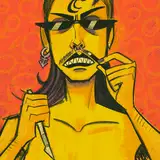
In the beginning, the Earth was lonely. She felt a great emptiness and need inside her. She looked onto the world, her eyes resting on the great city. She saw there a blacksmith with muscular coiled arms and scorched skin. He bared his white teeth in a taut grimace as he worked the flames.
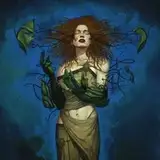
Earth was entranced. She took the form of a great giant of soil and entered the city. She scooped the Blacksmith up into her arms and carried him into the mountains.
Once the Blacksmith learned that she was the Earth, he was receptive to her warm, wet body. She enveloped him in her enormous thighs, and he clung to her while driving himself deep within her. They coupled for several nights before the exhausted and dazed Blacksmith returned to the city carrying a large boulder under his arm.
The boulder grew into a child, which was named Arrkzeer, or ember, and he would later be known as the great hero KokzirBraalh.
As Arrkzeer grew into a young man, he showed incredible strength as well as a resistance to heat and flame. However, he had an aversion to water, and because of this would never bathe. The citizens of the town hated his stench and his pranks. He would often light the robes of the men and women on fire, forcing them to strip their clothes off or run in a panic with flames eating at their rears.
He was especially hated by Babbetter, his sister and the high priestess of the city. She had an enormous disdain of Arrkzeer’s divine heritage and brash personality.
Thus began the feud between Arrkzeer and Babbetter.
Babbetter poisoned Arrkzeer with a poison made from thirty-five cobras. However, with his great strength Arrkzeer did not die. He suffered horrible ailments in his bowels that left a cloud of gagging stench over the city. Babbetter herself was constantly nauseous from the stench. He painfully expelled his waste over and over again, filling chamber pot after chamber pot.
Next, Babbetter summoned a pack of angry wolves to tear Arrkzeer limb from limb. They invaded the city and Arrkzeer heroically held them back, protecting the citizens. After fighting with the wolves for nearly a day and suffering great wounds, he befriended them with his wild spirit. The wolves turned on Babbetter’s commands and confronted her in the temple. However, Babbetter was born under a lucky star and, instead of attacking her, the wolves showed her friendship-without-rest, which made her howl with rage for the rest of the night.(1)
(1)Translation Note: There seem to be many contradictions with the end of this passage. It is unclear why Babbetter would react so negatively to the idea of friendship. Perhaps there is a long-forgotten context to the Moronoduma word used here, or perhaps the villainous Babbetter simply had an aversion to wolves.
Finally, Babbetter pushed Arrkzeer off a cliff and into the mouth of a giant hippopotamus where he was swallowed whole. But, because of his great strength, Arrkzeer survived and was released from the hippo in its excrement after three days.
An enraged Arrkzeer returned to the city covered in dung, much to the disgust of the citizens. He challenged Babbetter to wrestle in the middle of the town square to settle their feud once and for all. The boyish and prideful Babbetter could not refuse and fought Arrkzeer. They fought for a full day, from morning to night. Arrkzeer was weakened by his time in the hippo’s bowels. Babbetter fought with venomous rage that granted her surprising strength. But, despite cruelly attacking his two weaknesses(2) with her hands, she could not grip his body because he wisely did not clean off the slimy hippo shit. She was eventually defeated and, as punishment, her robes were stripped off, her legs were pulled apart, and her open flower and spread buttocks were exposed to the laughing crowds.
(2)Translation note: Arrkzeer’s two weaknesses are never mentioned again in any other story or myth. There has been much speculation among scholars as to what these two weaknesses could possibly have been, but without further context we may never know.
***
Even far into his adulthood, the son of Earth and the Blacksmith refused to wear any clothing. The people found the strong, smiling, naked hero impressive and distracting. It was at this point that he was given a new name, KokzirBraalh.(3)
(3)Translator’s note: KokzirBraalh is a combination of two Moronoduman words. The second, Braalh, is straightforward. It means donkey and originates from the Moronoduma onomatopoeia for braying. The first word, however, has multiple meanings, including manly, snake, long, and muscular. These words in combination likely mean “muscular donkey,” referring to KokzirBraalh’s great strength and stubborn personality.
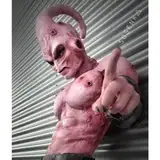
One day, the great king of the jungle beasts GuRarran came to the city in search of sport. He was a great reddish ape-man. He sneered at all of the clothed and civilized people of the city. His fig pouch(4) hung low and was full and enormous and swollen. His buttocks were like a horse’s. The giant GuRarran was disgusted by the city and began stripping the citizens of their clothes. He pulled them over his knee and punished their backsides with his broad hand. He urinated on the walls and columns of buildings and pelted the citizens with his excrement, taunting them to present him with a champion.
(4)Translator’s note: This is the only mention of a “fig pouch” in existing Moronoduma literature. It is unclear if this is a typical Moronoduman pouch that just happened to be holding figs or a specific type of pouch intended to carry figs. As we see later in the story, GuRarran has a connection to seeds and planting, so the fact that he carried a great many figs into the city may be to reinforce his position as a sort of jungle deity.
KokzirBraalh appeared and was immediately impressed by GuRarran’s scent and belly and musk as was GuRarran by Kokzir’s muscles and length(5) and dashing, grinning face. The two headbutted each other like mountain goats and snorted up each other’s scents. GuRarran challenged Kokzir to a duel in the jungle, which Kokzir immediately accepted. The great jungle king told Kokzir to bring a sword of powerful steel and left.
(5)Translator’s note: The word for length is used here in the tablet, but it is likely an error and is probably meant to refer to Kokzir’s height.
KokzirBraalh returned to his home to get his sword, but it was missing. He searched the entire city for his sword. He broke into homes and smashed through walls in his desperate search. The laughing Babbetter appeared and said that she had taken his sword and hidden it. She would only return it to him after he completed three quests. The enraged Kokzir had no choice but to accept.
For his first quest, Babbetter tasked KokzirBraalh to walk to the bottom of a lake and retrieve a golden clam. KokzirBraalh was terrified of the water, but he so deeply wanted to best(6) GuRarran’s powerful body that he accepted. Kokzir sunk to the bottom of the lake like a stone, and he walked across the lakebed to find the golden clam. With each step, he wanted to turn back, but the image of GuRarran in his mind’s eye forced him onward as if under a spell. He retrieved the clam and presented it to Babbetter.
(6)Translator’s note: There is some debate on the meaning of the Moronoduman word translated to “best” here. It is an uncommon word, but it seems to have a similar meaning to best, defeat, or conquer.
Secondly, Babbetter asked KokzirBraalh to allow his jewels(7) to be smashed with the giant executioner’s hammer. Kokzir was distraught but accepted. He clenched his teeth with every blow that was powerful enough to crush skulls. But even in his awe-inspiring strength, Kokzir eventually gave in to wails of despair. The great KokzirBraalh was humbled, and his body crumpled in pain.
(7)Translator’s note: KokzirBraalh is not said to collect jewels in any other part of the text or any other myth about the character. In fact, it seems against his character as a “naturalistic hero” to value gemstones so highly. But, as we see by his reaction later in the passage, these gemstones must have been very important to him, wherever they came from.
Lastly, Babbetter tasked KokzirBraalh with serving as a mare in her stables(8), which he did with pained protests for many nights. Babbetter watched it all with great laughing joy. The sneaky Babbetter arranged for traveling dignitaries from the east to stay in the city during this time, and six bull elephants were kept in the stables. The angry Kokzir was forced to serve all of them. Kokzir learned incredible self-control, and his manhood(9) did not betray him in the exhausting heat he endured each night, much to Babbetter’s annoyance. At the end of his task, the great Kokzir was again humbled and sore, so much so that he could barely stand and walked with a wide gait. He moved like a duck to Babbetter’s temple, ready to reclaim his sword.
(8)Translator’s note: There has been much debate within scholarly communities about what this phrase could mean. It is likely a Moronoduma idiom lost to time. Through context clues, we can decipher that Babbetter is forcing KokzirBraalh to be her stable hand, which the free and unruly Kokzir treats as a painful punishment. It is obvious from the last lines of this passage that KokzirBraalh is sore from constantly cleaning the stables.
(9)Translator’s note: Obviously, this means his pride in this context.
Babbetter laughed and told KokzirBraalh that she never had his sword, and she did not know where it was. Kokzir was enraged and released mighty screams out of his hairy chest that fell Babbetter’s temple, crushing her. However, Babbetter was blessed by a lucky star when she was born and somehow survived.
Very frustrated that he would not be able to duel with GuRarran, Kokzir lit a bonfire and asked the Goddess of Flame for a new sword.
She saw Kokzir’s sadness and soreness and agreed to grant him a weapon. Taking her burning hands, she grabbed Kokzir’s member and crafted it. Kokzir winced with pain, but his great strength allowed him to endure. His member swelled and grew to five feet in length in her fiery grip. It became tempered like steel. Because of the self-control Kokzir was forced to learn in Babbetter’s stable, he was able to control his member and maintain its new erect and metallic shape.
KokzirBraalh traveled into the jungle, to the lair of the great jungle king. He was ready to duel and entered GuRarran’s cave. GuRarran was lounging in a nest of leaves, watching the naked man enter with narrowed, focused eyes.
GuRarran had been expecting KokzirBraalh and had lit candles and incense to welcome the hero. GuRarran was impressed with Kokzir’s improvised weapon and laughed heartily. He picked up a rhinoceros bone as a club and they fought.
They fought for three days without rest, coating their bodies in sweat and stink. KokzirBraalh swung his erection against the club again and again. Kokzir’s steely member broke the rhinoceros bone at noon on the third day, signaling Kokzir’s victory.
Defeated, GuRarran presented himself to KokzirBraalh and asked to be punished. KokzirBraalh took his sword and ran GuRarran through from behind with the energy of a stallion hundreds of times for many nights.(10) GuRarran was overwhelmed with such joy in their burning union that he released his seeds upon the ground, and Kokzir gifted GuRarran deeply with his own seeds.(11)
(10)Translator’s note: It is unclear how Kokzir found his sword again in this passage. It may be an error on the part of the original author. The fact that GuRarran was able to survive hundreds of stab wounds shows that he has impressive strength rivalling a god.
(11)Translator’s note: The almost ritualist exchanging of seeds in this passage seems to suggest some sort of ancient Moronoduma agricultural ceremony. Perhaps ancient Moronoduman tribes exchanged seeds and planted them during harvest ceremonies or as peace offerings after great conflicts.
Both were pleased and exhausted and spent. They slept-big-ladle-over-small-ladle(12) in their exhaustion.
(12)Translator’s note: This complex word has no equivalent in English and is another Moronoduma idiom unfortunately lost to time.
Translator’s Biography
Sir Dr. Finnegan, PhD. is the world’s foremost expert on Moronoduma culture. Born in London, England, he has dedicated 44 years of his life to understanding and translating the works of this ancient and long-forgotten island. He has published over 76 books on Moronoduma. Dr. Finnegan was knighted in 1985 following his translation of The Masculine Poems of Heart, a collection of ancient Moronoduman poems about masculine comradery and friendship, which was one of Queen Elizabeth the Second’s favorite books. In interviews, Queen Elizabeth said she kept the book “in her bedside table” – no doubt next to her Holy Bible – so she could read from the ancient Moronoduman text the instant “the mood struck her.” Dr. Finnigan has been married 12 times and currently teaches classes on ancient history and literature at Cambridge. Dr. Finnigan possesses an IQ score of 250, greater than Einstein.