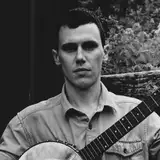
George R. Gibson demonstrates his two-finger approach to the classic Appalachian banjo song, "Darling Cora" at this year's Cowan Creek Mountain Music School. Gibson (b. 1938 in a log house at Bath, Kentucky) learned this and other pieces from his banjo playing father, Mal. The instrument is tuned (relatively) gCGCC. Many thanks to our very own Justin Hoffman for filming this national treasure.
"I was born May 14th, 1938 at Bath, in Knott County, Kentucky. Bath was a rural post office, now discontinued, on Little Carr Creek near the headwaters of the Kentucky, Big Sandy and Cumberland River systems. Little Carr Creek is called Burgeys Creek by local people in honor of the Amburgeys, who were early settlers in the area. The cabin in which I was born was built around the turn of the century by the earliest known Kentucky dulcimer maker, James Edward "Encle Ed" Thomas.
"My parents were Mal and Letitia Hammons Gibson. They had a country grocery store and mill on Burgeys Creek at the confluence of Big Doubles, Little Doubles and Buffalo Creeks. My Gibson ancestors came to Knott County from North Carolina via Scott County, Virginia. My Hammons and Adams ancestors moved initially from eastern Virginia to Wilkes County, North Carolina in the 1700s and then migrated to eastern Kentucky in the early 1800s.
"My father, Mal Gibson, learned to play [banjo] around 1905-1910. I had not obseved exactly how he played until he visited me when he was about 90 years of age. He played a very unusual stroke style; his thumb did double time on the fifth string and would drop occasionally to pick an interior string. He would also occasionallyreach down with his thumb and brush up on the strings. He did this while picking the interior strings with the nail of his first finger, picking the first string with the nail of his second finger and brushing down with the nails of his second and third fingers (which were slightly parted to get a scratchy sound). He also did a lot of plucking, pulling and hammering with his left hand.
"When playing stroke style I create sounds similar to my father's playing by using different techniques. I do pick some notes on interior strings with my thumb, however, instead of brushing up with my thumb, I more often brush up with the ball of my first finger while at the same time plucking a string with my left hand. I pick most notes on the down stroke with the nail of my first finger while brushing down very quickly with the nail of my third finger. My cousin, Herman Gibson, recently played 'Hook & Line' for me in a stroke style; he brushed up with his thumb just as I heard his brother, Alex, do some forty years ago. I have adopted this technique and added it to tunes such as 'Cluck Old Hen.' It is important that this technique not be lost.
"I regret to say that I never asked my father anything much about his banjo playing style, or how and when he learned to play, until he was ninety. He then told me that his father kept a banjo sitting in the corner of the cabin and the he was about five when he began to play. Mel Amburgey recalled that he, my father and my father's sister, Flora, learned to play around the same time; he maintained that they could play 101 banjo songs in one tuning.
"There is a simple explanation for the difference in my techniques and my father's, and in the widely varied picking methods among Knott County and eastern Kentucky banjo players generally. It stems from a strong cultural bias that prevents young mountaineers from questioning their elders closely about a task or skill. Children in Knott County were expected to learn by listening and observation. For instance, I was putting gears on a team of mules and plowing by about the age of twelve. I never asked my father how to do any of this--it was something I was expected to learn on my own."