Rona (Setting Worldbuilding)
Added 2021-03-04 18:00:04 +0000 UTCFrom the very beginning, I always envisioned the game starting in a “tutorial” area that was separate from the main setting. There were a few reasons for this:
1) I wanted a contained area for the player to explore where I could test my game mechanics. Going into this, I had a plan, but I wasn’t exactly sure how to implement all of the mechanics I had in mind and I didn’t know how the process of executing them would go. Keeping the first chapter contained meant that I could try out different things without worrying about keeping track of every decision across later chapters. Mechanics I am testing in Chapter 1 include:
- Approval loss and gain
- Faction approval loss and gain
- Romance gain and balancing the different continuities depending on how many romance points the player has gained with a character (Aeran is my guinea pig, sorry Aeran)
- Balancing different continuities and flavour text depending on companion/faction approval
- Fight scenes
- Trickle-down consequences, where a decision you made earlier comes back to haunt you (or help you) later on, or where multiple decisions build together towards a certain outcome. I specifically don’t want it to be as easy as “go back three pages and choose a different option” if the player gets an outcome they don’t like, I want outcomes to grow organically over multiple choices
- Inventory management and haggling
In many ways, Chapter 1 is a microcosm of the entire game.
2) I wanted to establish the scope and breadth of the world before trapping the player in Velantis for the rest of the game. It also gives me the time to properly establish Aeran, how he and the MC work together, and what Wayfarer life is like before the player gets shoved into a very specific set of circumstances.
When Wayfarer was a Dragon Age game, I had the player start in a small coastal town separate from the main setting so I could have the player experience their recruitment into the Inquisition first-hand, rather than relaying the facts through exposition later on. Shades of this has transferred over to the game, namely:
- Chapter 1 takes place in a coastal “backwater” town
- The player character has a mission/goal they are pursuing outside the main action
- The player character is approached by an outsider who wants to recruit them into their organization for a mission
- Regardless of their decisions, the player is either willingly or unwillingly recruited into the organization and embarks to another city
Rona has changed a lot over time. When I was creating Wayfarer’s setting, I had envisioned the city as a small town in a coastal wetland. For some reason, I had images of Myst’s Channelwood setting in my head when I was writing. I haven’t touched Myst in years—I was a little kid when it came out and I never progressed very far (the atmosphere freaked me out, there was one world where you discovered a dead body in a chest, and the point-and-click puzzles were too difficult for me, so I got frustrated easily). I have never finished this game, I don’t think I have even looked at it since I was 8 or 9, but I remember Channelwood very clearly: trees growing out of the water, with a village composed of boardwalks and huts in the trees.

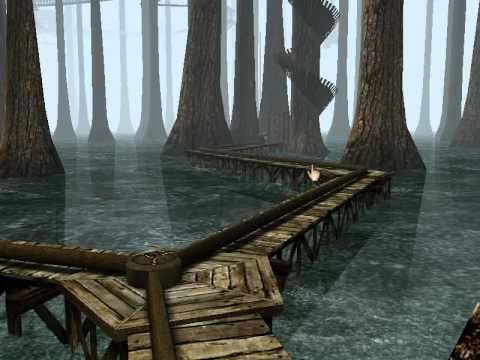
As I was trying to figure out what the surrounding environment looked like, I researched different coastal wetlands in search for that “trees growing out of the water” look. I sourced visual references from everything from the Louisiana wetlands to the wetlands of Thailand.


I was attached to the idea of Rona being a city built in a place where you really shouldn’t have a city. I kept thinking visually about a tug-of-war between the environment and human interference. Rona was originally supposed to be a small village, but when I added the Exploration mechanic, the city grew. I knew I wanted 4 areas for the player to explore and to serve different functions. Adding locations like the Cove (mercantile district, where the player can buy items for later use) and Edgewater (the slums, where the player’s home is located) grew the city organically. And because the city grew, the lore justifying its layout had to grow as well.
Originally there was only one crime lord dominating the city. The Crimson Count was supposed to have complete control over Rona. By adding the “missing artefact” mission, I had to figure out who opposed him and who had conflict with him. Adding the Viridian Lady as a rival expanded Rona’s political system and then I added on to that with the creation of the Seven.
Around the same time I was thinking about Rona’s particular position on the map and why it was so far flung from the game’s main setting. Its history of being a failed Arathian colony came from a couple of places. The first source of inspiration was the history of Londinium, post-Roman Britain, and how Roman settlements changed after the military left. The second was the history of the Republic of Pirates in Nassau, Bahamas in the early 18th century.
(As some of you know, my MFA research revolved around early 18th century piracy and I tend to draw on that research subconsciously.)
I had already established a pirate colony in Wayfarer’s world (the Dravaden Isles) and, in a way, Rona became an extension of some of the worldbuilding I had done there. I wanted the city to feel like it existed outside any kind of standard national laws, that it had rejected the systems that had been in place under Imperial rule, but it still had its own rules and structure. Instead of just being crime lords and pirates, the Seven developed a more political edge in the way they interact and control Rona.
Keeping with my pirate inspiration, the Seven are named after different historical pirates, with the exception of the Crimson Count (don’t know where I got Cere Nalos, that name just popped into my head one day and I ran with it):
- Anselma Malley – Malley comes from Grace O’Malley, a 16th century Irish pirate
- Flora Goldhorn – Goldhorn is Hornigold reversed. Benjamin Hornigold was an early 18th century English pirate, active during the Republic of Pirates. Flora comes from Flora Burn, an 18thcentury English pirate active during the 1740s and 1750s.
- Leva Vane – Leva comes from Olivier Levasseur (French pirate, early 18th century) and Vane comes from Charles Vane, another early 18th century English pirate.
- Sayida Burn – Sayida is a misspelling of Sayyida al Hurra, a 16th century Moroccan pirate. Last name also comes from Flora Burn.
- Mari Rack – An absolute gobbledegook mashup of Mary Read and Jack Rackham, two early 18th century English pirates and also two historical characters in the play I wrote for my MFA. Mari Rack’s alias, the Calico Lord, is plucked from Jack Rackham as well (he was sometimes referred to as Calico Jack Rackham because of the colourful clothes he reputably wore).
- Samwell Every – Samwell, derived from Samuel Bellamy (another pirate part of that early 18thcentury pirate group, the Republic of Pirates was very, very busy). Every, adapted from Henry Every (late 17th century pirate, and possibly one of the most famous pirates in history).
I think a fundamental part of fantasy worldbuilding is that even if you don’t tell the audience ever little detail, it’s still important for you, the author, to know those details. You don’t need to state every little piece through exposition, but the more grounded those details are to you, the more grounded they will feel in your writing.
Comments
I'm very biased, but I think it's worth a revisit! It hasn't aged incredibly gracefully, it was a pioneer for a lot of things and it shows, but keeping in mind the time period it came from, I think it's worth it and it's much easier to figure out the puzzles nowadays too since we're more used to that style of gameplay in games, I think. There are two versions, Myst Masterpiece Edition which is the old point-and-click slideshow version, and RealMyst Masterpiece Edition, which is freeroam 3D. I feel the original slideshow version is a little better if only because it helps draw attention to things just from the nature of the view being framed around particular slides, but both are good! If you happen to get past Myst, I definitely recommend the sequel Riven even if only to click around in. They absolutely nailed the aesthetic feel much moreso than Myst did, it's one of my go-tos to recommend for a game that brings an aesthetic to life to the point of immersion. The puzzles are incredibly difficult, there are technically only two major ones in the entire game, but they're tied into the worldbuilding really well in my opinion. I like to boot it up and just run around sometimes because it's that immersive. Though of course, that's also me with my rose-tinted glasses on :) If or when you get a chance, I hope you enjoy yourself!
Rachel Costa
2021-03-14 22:39:17 +0000 UTCAhh thank you, Rachel! I really want to revisit Myst. I think it speaks to something special about the game that its images and design still stay with me even though it's been like... Over 20 years since I last looked at it. 😂 I was too young to play it properly, I never progressed very far, but I think it would be interesting to go back as an adult.
idrella
2021-03-14 21:55:24 +0000 UTCI am a huge Myst nerd so seeing Channelwood act as part of your inspiration is near and dear to my heart. I feel like you did great at the evolution of that concept, Channelwood is gorgeous but empty and very clean just from the nature of 90s 3D graphics generally being basic and uncluttered, so Rona is kind of the opposite side of that coin: populated, lived in, with weathering and rot from both the water and the populace. Especially when it's populated by pirate analogues!
Rachel Costa
2021-03-14 21:32:37 +0000 UTC